Understanding Fume Extraction Arm Sizing
What Size Fume Extraction Arm Do I Need?
When choosing a fume extraction arm, it’s easy to assume that a larger arm will capture more fumes and provide better performance. In reality, that’s not always the case. Oversizing your arm can actually lead to poor performance, inefficient capture, and wasted energy. The key is to match the arm size to the application, workspace, and airflow requirements.
Fume extraction arms are typically available in 4", 6", and 8" diameters. Each size is designed to move a specific amount of air (CFM) and cover a certain capture area. But the larger the diameter, the more airflow (and suction power) your fan or fume extractor needs to maintain proper capture velocity.
- 4" Fume Arm: Usually designed for around 300–450 CFM
- 6" Fume Arm: Typically operates at 600–850 CFM
- 8" Fume Arm: Can require 1000–1200+ CFM
If your extraction unit or duct system can’t provide that airflow, the larger arm won’t capture effectively — even though it looks more capable.
Standard Welding Booths and Average Welding
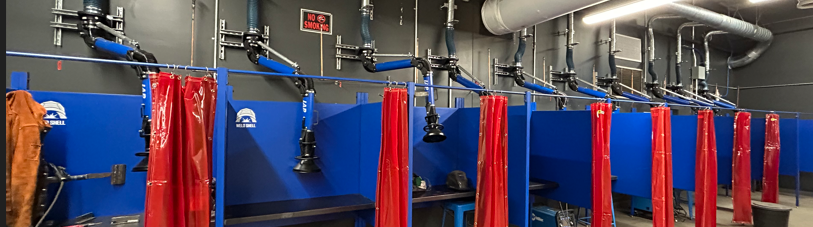
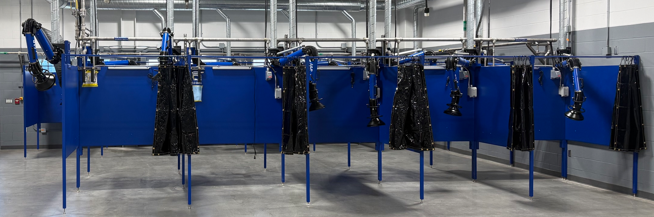
For standard 4x4 or 5x5 welding booths, maintenance shops at factories, and most school welding programs, a 4" fume extraction arm is often the ideal choice. These environments typically involve welding smaller parts or short-duration welds, and the compact design of a 4" arm makes it easy to position within tighter spaces.
A properly sized 4" arm operating around 400 CFM can effectively capture fumes without overpowering the space or requiring a large fan. In fact, smaller booths can struggle to accommodate the reach and bulk of a 6" or 8" arm.
Moderate Welding or Grinding in Medium Booths
For more demanding environments — such as industrial welding departments that run multiple shifts or schools with 6x6 welding booths — a 6" fume extraction arm is often the right fit. These arms move a higher volume of air to handle frequent or continuous welding while maintaining strong capture performance.
A 6" arm paired with an appropriate extractor (usually around 700–800 CFM) provides great coverage for small- to medium-sized parts without being excessive. It’s a solid middle ground between mobility, reach, and performance for everyday industrial use.
Large Workpieces or High-Volume Production Areas
An 8" arm may be justified for large workpieces, heavy fabrication, or multi-operator setups, but these cases are the exception rather than the rule. An 8" arm demands significant airflow — often over 1000 CFM — to maintain capture velocity. Unless your system is specifically designed for that volume, it will underperform.
Why Bigger Isn’t Always Better
A common issue we see is customers installing 6" or 8" arms in small welding booths. The result? The capture efficiency drops because the airflow velocity through the arm slows down. Even though the duct is larger, the same fan or fume extractor now has to move much more air — which it usually can’t.
In short, oversizing the arm leads to weak suction and poor capture, especially at the hood where it matters most.
A Balanced Approach
A properly sized arm will always outperform a poorly sized one. For instance, a well-balanced 4" arm moving 400 CFM will perform far better than an 8" arm operating below its designed airflow. The size should match the airflow capacity of your system — not just the space you have available.
When your arm, fan, and workspace are properly matched, you’ll achieve consistent capture efficiency, easier positioning, and longer filter life.
Final Thoughts
When choosing a fume extraction arm, consider how often you’re welding, the size of your parts, and the airflow capacity of your system. Most shops find that a 4" or 6" fume arm provides excellent performance for day-to-day welding, grinding or soldering tasks — with easier positioning and less strain on their fume extractor.
If you’re unsure which size is best for your setup, our team at IAP Air Products can help evaluate your space and recommend the right solution. Whether you’re running a small fabrication area or a large production floor, proper sizing will always deliver the best results.
SHARE THIS POST